E-bike Laws, Safety & Important Info
E-Bikes in Neptune Beach
Overview
Electric bicycles (e-bikes) are increasingly popular but have also created new safety and enforcement challenges. The following information outlines relevant laws, ordinances, safety concerns, and best practices for parents and riders in Neptune Beach.
Quick Facts:
- Can I ride my e-bike on the beach?
- Yes, but only if you ride under 15 mph and operate safely.
- Do I need a license or registration?
- No. E-bikes are regulated as bicycles under Florida law.
- Can my child ride an e-bike?
- Yes, but they must wear a helmet if under 16 and should be taught how to ride safely and responsibly.
- Can I modify my e-bike to go faster?
- No. It is illegal to modify or tamper with the speed controls unless you update the classification label.
What Parents Can Do:
We highly encourage parental oversight and control when buying an e-bike for your child. While law enforcement is dedicated to ensuring the safety of its residents and visitors alike, it’s the responsibility of parents to educate and control their children. If you are a parent, and buy your child an e-bike, you need to have a conversation with them about responsible-riding. Parents should:
- Ensure children under 16 wear helmets.
- Educate young riders on rules of the road and the importance of yielding.
- Educate young riders about consequences for reckless operation.
- Limit e-bike usage in high-pedestrian areas.
- Inspect bikes regularly for mechanical safety and compliance.
Where Can E-Bikes Operate?
- E-bikes are permitted anywhere regular bicycles can go, including roads, bike lanes, and multi-use paths.
- Neptune Beach Ordinance 2025-06 allows e-bikes on beach sand if operated safely at speeds of 15 mph or less.
- Some sidewalks or trails may have local restrictions. Always observe posted signage.
Speed and Equipment Requirements
- E-bikes must not exceed their class speed limits while under motor power.
- Motor must disengage when the rider stops pedaling or applies brakes.
- Riders must use:
- A front white light (visible from 500 feet) and a rear red light or reflector (visible from 600 feet) when riding after sunset.
- A helmet if under 16 years old (recommended for all riders).
Common Safety Concerns
- E-bike crashes have increased due to high speeds, inexperience, and failure to yield.
- Many operators, especially juveniles, are unfamiliar with traffic laws.
- Helmet use and visibility remain major safety gaps.
Florida State Law (F.S. 316.20655)
- E-bikes are treated the same as bicycles.
- No license, registration, or insurance required.
- It is illegal to tamper with the motor or increase speed unless the classification label is updated accordingly.
Neptune Beach Municipal Ordinances
- E-bikes are allowed on the beach but must operate at 15 mph or below.
- Riders must obey all stop signs, signals, and yield to pedestrians.
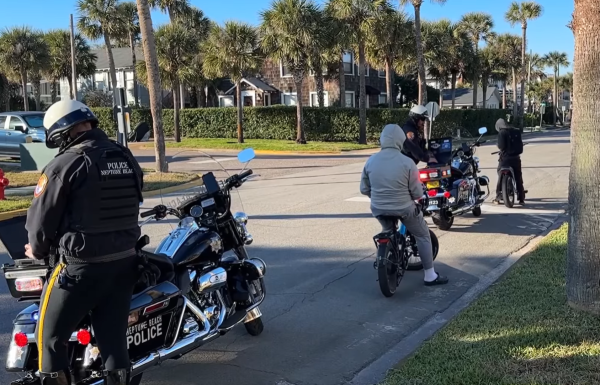
- The Neptune Beach Police Department strictly enforces reckless operation.
- E-bikes must have lights if operated at night, just the same as normal bicycles.
- Enforcement efforts have and will be coordinated with neighboring beach communities.
Fines:
- Riders aged 15 & older: $62.50 for violations.
- Riders aged 14 and younger: $15.00 for violations.
What Is an E-Bike?
Florida law defines an e-bike as a bicycle equipped with a motor of no more than 750 watts. It must have fully operable pedals and meet one of the following classifications:
- Class 1: Pedal-assist only, motor cuts off at 20 mph.
- Class 2: Throttle and pedal-assist, motor cuts off at 20 mph.
- Class 3: Pedal-assist only, motor cuts off at 28 mph (not permitted everywhere).
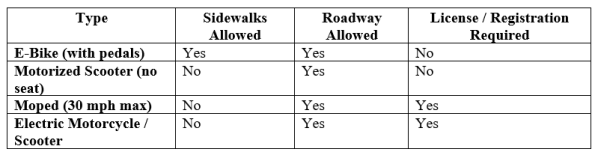
All e-bikes must have a manufacturer label stating the class, top assisted speed, and motor wattage. Note, an e-bike must have fully operable pedals to be classified as an electric bicycle under Florida law (F.S. § 316.003(23)). If it does not have pedals, it is no longer considered an e-bike and may be classified as one of the following:
- Motorized Scooter: No pedals, no seat, low speed.
- Moped: Often lacks pedals, must be registered, requires a license, and cannot be operated on sidewalks or bike paths.
- Electric Motorcycle: Higher speed vehicle requiring registration, insurance, and a motorcycle license endorsement.